
Steel microstructure is the fine structure of its constituents that is made visible by magnification over 25 times. It is a function of the carbon content and the transformations that occur during the process of forming the steel. In addition, it has a significant effect on the mechanical properties of steel, so it is of importance in engineering applications. In this article, we will review the types of steel microstructure, the microstructure of high carbon steel, mild steel, and stainless steel, as well as heat treatment and finishing effects.
Types of Steel Microstructure
The microstructure of pure iron, which is the basic constituent of steel, is like a 3-D lattice of billiard balls with small gaps or interstices between. Depending on the heat treatment process, small elements such as carbon and nitrogen can fit into these interstices. Larger elements including silicon, phosphorus, and magnesium can substitute the iron atoms in the lattice. This is the basis for the formation of steel, where the microstructure is altered to make up different constituents that meet the needs of an application.
Ferrite Microstructure
When carbon atoms are only in a small fraction of the interstices of the iron lattice, the steel has a ferrite microstructure. This type is a body-centered cubic that is soft and ductile, like pure iron. Ferrite microstructure typically contains small amounts of carbide and cementite at the grain boundaries, especially after deformation or processing. Its microstructural phase limits the amount of carbon in the interstices to 0.02% at 1,340 °F (725 °C). While at room temperature, the chemical composition drops to 0.006%.

Austenite Microstructure
This microstructural phase has larger interstitial gaps that can contain up to 2% carbon at 2,100 °F (1,150 °C). Unlike ferrite, austenite has a face-centered cubic structure, and the increase in carbon content results in higher tensile strength. During heating, austenite grain size and uniformity greatly influence subsequent phase transformations and the development of final properties. Austenite can transform into ferrite, pearlite, bainite, or martensite depending on the cooling rate and presence of alloying elements.

Martensite Microstructure
Cooling austenite at a fast rate (above 86 °F) limits the amount of carbon atoms that diffuse from the crystal structure, resulting in martensite formation. As a result, there are distortions and strains in the iron lattice leading to a body-centered tetragonal structure. This phase is associated with high level of hardness but usually undergoes further heat treatment to reduce distortions and improve toughness. In some cases, retained austenite may remain in the microstructure, depending on the alloying content and quenching temperature.

Bainite Microstructure
Bainite forms at a temperature range between that of pearlite and martensite during continuous cooling. It is a fine mixture of ferrite and cementite and can be categorized as upper bainite and lower bainite depending on the transformation temperature. Lower bainite typically forms at lower temperatures and exhibits better toughness due to its finer lamellar structure and precipitates. Bainite combines strength and toughness and is commonly found in heat treated medium carbon steels.
Microstructure of High Carbon Steel
Generally, carbon steel grades depend on the weight percentage of carbon content present in its structure. For high carbon steel, this value is between 0.6 and 1.25%, while its manganese content is approximately 0.3 to 0.9%. Although this makes it a very hard, wear-resistant steel, they have low levels of ductility. As a result, they are ideal for making edged tools, chains, gear wheels, springs, and high-strength wires.
Microstructure of Mild Steel
Mild steel has a low carbon content ranging from 0.05 to 0.30%, which makes it malleable, ductile, and cheap to produce. Because of these features, it is predominant in several applications in industry. Although it inherently is of low strength, it can form alloys with other elements such as chromium, nickel, and manganese to produce high-tensile steel. This type of steel serves in making cans, pipes, and construction components.
Stainless Steel Microstructure
The key attribute of the stainless-steel microstructure is the presence of a minimum of 10.5% chromium. This results in corrosion-resistant steel (CRES) because the chromium combines with oxygen to form a thin, stable passivation layer. Moreover, if there is a scratch on this layer, a self-healing process quickly forms another protective layer for the material. This feature makes stainless-steel preferable over plated metals in corrosion resistance applications, but it is more expensive.
There are different grades of stainless-steel where the microstructure is altered to suit mechanical and corrosion resistance requirements. These grades include ferritic (10.5-18% chromium and 0.08-0.15% carbon), martensitic (12-18% chromium and 0.10-1.2% carbon), austenitic (16% chromium and 8+% nickel), and duplex (19-32% chromium and 5% molybdenum).
Heat Treatment and Finishing Effects
Heat treatment refers to heating or cooling steel using predetermined methods to achieve desirable changes to its mechanical properties. Moreover, some of the properties that significantly change are ductility, yield strength, and hardness. Others, such as thermal and electrical conductivity alter slightly. There are several heat treatment methods, but this section reviews the major types.
Annealing
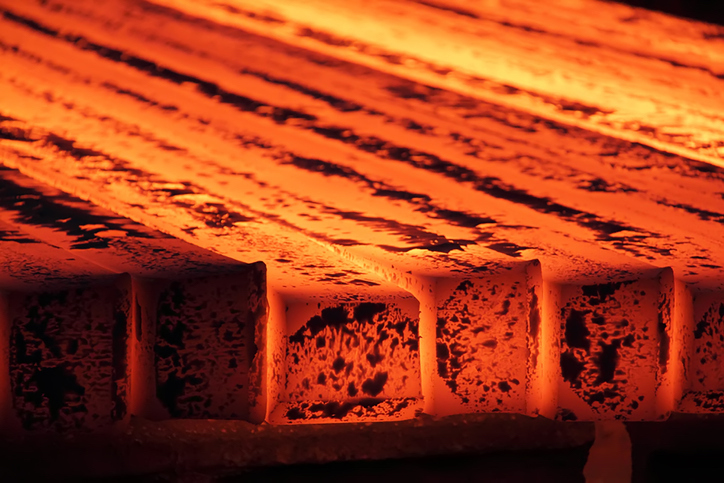
Annealing of steel involves heating it slowly to a set temperature depending on its carbon content. Then it is cooled gradually by burying it in an insulation material or simply leaving it to cool down inside the furnace after switching it off. Moreover, the amount of cooling time relates to the steel type and mass. Due to this treatment, there is stress relief, an increase in ductility, and improvement in the grain structure of the steel microstructure. Also, it enhances the steel’s suitability for cold working and machining. There are various types of annealing such as process, isothermal, and full annealing.
Normalizing
After undergoing casting, forging, machining, or heat treatment, normalizing serves to remove any internal stresses from the steel. During the normalizing process, the steel is first heated until it completely transforms to austenite. Followed by air-cooling at about 100 °F (38 °C) per minute. This gives the steel a fine pearlite microstructure, more uniform than what comes from annealing steel. As a result, the steel has higher strength, hardness, and toughness. Thus, it is ideal for components that support significant loads, and those that require impact strength.
Hardening
As the name suggests, this method aims to increase the hardness of the steel. This is achieved by heating it to a specified temperature, then cooling it rapidly by submerging it in water, oil, or brine. Although the hardness and the strength of the steel increase, its brittleness increases as well. The hardening process is more effective in alloy steel, rather than in carbon steel and is good for applications where wear resistance is important. Under microscopy and electron microscopy, hardened steel shows refined microstructures and the formation of martensite and retained austenite.
Tempering
In some situations, the hardening process makes the steel too brittle, so it requires softening. Tempering involves heating quenched steel to a temperature less than its eutectoid temperature, and subsequently cooling it in still air. As a result, this relieves some internal stress in the steel microstructure, making it more ductile.
Metallurgy and Microscopy
In materials science and metallurgy, microscopy plays a key role in analyzing steel microstructure. Optical and electron microscopy techniques allow metallurgists to study microstructural constituents, grain size, grain boundaries, and phase constituents such as graphite, oxides, cementite, and precipitates. These observations help in correlating the steel’s microstructure with mechanical properties like tensile strength and ductility. Microstructure control through heat treatment and alloying continues to be a core focus in developing advanced steels with optimal performance.