
Selecting the right material for manufacturing high-performance components is critical to ensuring durability, efficiency, and cost-effectiveness. Titanium carbide (TiC) and tungsten carbide (WC) are two common ceramic-metal composites, renowned for their exceptional hardness, wear resistance, and thermal stability. While both materials excel in demanding applications, their distinct properties make each more suitable for specific industries and use cases. This article compares titanium carbide vs tungsten carbide, analyzing their mechanical properties, durability, thermal performance, and cost considerations. We will explore which of them is ideal for cutting tools, wear-resistant coatings, industrial dies, aerospace components, and other precision manufacturing applications. Whether designing high-speed machining tools or heavy-duty industrial parts, understanding their differences will help you make an informed decision.
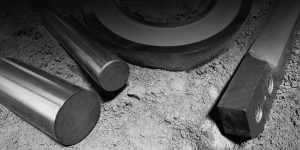
What Are Titanium Carbide and Tungsten Carbide?
Titanium Carbide (TiC)
TiC is a refractory ceramic compound of titanium and carbon atoms arranged in a face-centered cubic crystal lattice. Generally, it is integrated with other metal matrices like steel or nickel to bolster toughness. TiC has a remarkable hardness of 2800-3200 HV and a melting point of 3160°C. Also, it thrives in extreme conditions, resisting oxidation up to 800°C. Because of the covalent nature of TiC atomic bonds, it has unparalleled mechanical strength and thermal stability. This solidifies its role in high-stress and precision-driven industries.
Tungsten Carbide
Tungsten carbide (WC) is a super-hard, ultra-dense ceramic-metallic composite comprising tungsten atoms bonded with carbon in a hexagonal lattice. Generally, it is combined with a binder like cobalt or nickel at 6-12% for increased toughness. Pure WC, while extremely hard, is brittle and prone to fracturing under impact, which is why it’s commonly combined with a binder. WC has a hardness of 1800–2400 HV and a density of 15 g/cm³, making it well-suited for abrasive and high-stress environments.
Comparing Titanium Carbide vs Tungsten Carbide
Thermal Conductivity of Titanium Carbide vs Tungsten Carbide
The thermal conductivity of WC and TiC varies significantly, influencing their performance in high-temperature applications. For example, WC exhibits a thermal conductivity of 84–100 W/m·K due to its dense hexagonal lattice and metallic cobalt binder. These provide efficient phonon (heat-carrying lattice vibration) and electron-mediated heat transfer. On the other hand, TiC has a lower thermal conductivity of 21-25 W/m.K. TiC’s lower conductivity is due to its covalent bonding and FCC structure, which scatters phonons and lacks free electrons for thermal transport. So, the lower conductivity of TiC makes it prone to localized heat buildup, but advantageous in thermal barrier coatings.
Chemical Composition and Crystal Structure Differences between Titanium Carbide and Tungsten Carbide
Tungsten carbide consists of tungsten and carbon atoms bonded in a hexagonal close-packed (HCP) crystal lattice. This is often combined with a metallic binder like cobalt to form a cermet. Titanium carbide, in contrast, comprises titanium and carbon atoms arranged in a face-centered cubic (FCC) lattice, typically blended with binders such as nickel or molybdenum. The structural difference lies in their atomic packing: Tungsten carbide hexagonal structure prioritizes density and impact resistance, while titanium carbide cubic lattice enhances thermal stability.
Mechanical Prosperities
- Hardness: Titanium carbide is significantly harder with a hardness range of 2800-3200 HV, while tungsten carbide has hardness values between 1800-2400 HV. This in turn makes titanium carbide superior in applications requiring extreme wear resistance.
- Toughness: Tungsten carbide, with its metallic binder like cobalt, offers higher fracture toughness values of 7-13 MPa.m1/2. Whereas TiC in combination with cobalt have a toughness value ranging 1.3-3.8 MPa.m1/2. The toughness of TiC is dependent on factors like the grain size and crystallographic orientation (alignment of a crystal’s lattice structure relative to an external reference frame).
- Density: Tungsten carbide is much denser, with density of 15 g/cm3 making it heavier and ideal for application where mass aids energy transfer. On the other hand, TiC has a much lower density of 4.9 g/cm3, making it ideal for lightweight applications.
- Compressive Strength: WC can withstand higher crushing force up to 6000 MPa due to its dense structure. As a result, WC outperforms TiC, which withstands up to 4000-5000 MPa, making it more suitable for lightweight and high-hardness roles.
Thermal and Oxidation Resistance
Analyzing the thermal and oxidation resistance is critical when evaluating the stability and performance of a material in extreme environments. TiC exhibits exceptional high-temperature resilience, with a melting point of 3160°C and oxidation resistance up to 800°C. This makes TiC ideal for applications that demand prolonged exposure to heat and oxygen. In contrast, WC, despite its lower melting point of 2870°C, rapidly oxidizes above 500°C, restricting its utility in unprotected high-heat settings. This highlights TiC’s advantage in oxidative environments.
Electrical Properties of Titanium Carbide vs Tungsten Carbide
Tungsten carbide and Titanium carbide exhibit stark differences in electrical conductivity due to their distinct atomic structures and bonding mechanisms. WC is electrically conductive, with a resistivity of approximately 20-30µΩ.cm. This property is due to its hexagonal lattice structure and the metallic bonding contributed by its cobalt binder. In contrast, TiC is an electrical insulator, with resistivity exceeding 106 µΩ.cm, because of its covalent-dominated bonding in the FCC lattice. This insulating nature makes TiC unsuitable for electrical discharge machining (EDM), but ideal for applications requiring electrical isolation.
Manufacturing and Cost Difference
WC is manufactured through energy efficient powder metallurgy, leveraging readily available tungsten resources and minimal secondary processing, ensuring cost-efficiency. On the other hand, TiC synthesis demands carbothermal reduction of titanium oxide (TiO2) an energy-intensive reaction. This reaction requires temperatures exceeding 2000°C, then sintering with costly metallic binders like nickel. Moreover, TiC dependency on scarce high-purity titanium, complex purification process, and binder requirements, elevates production expenses. As a result, TiC components can be up to three times more costly than WC.
Best Applications for Tungsten Carbide
Mining and Mineral Extraction Tools
WC is the cornerstone of modern mining equipment due to its impressive hardness and abrasion resistance. Drill bits, roadheader picks, and tunnel boring machine cutters commonly utilize WC inserts to fracture hard rock formations like granite and quartzite.
Woodworking and Composite Cutting Tools
WC-tipped saw blades and router bits dominate woodworking for their edge retention. The fracture toughness of WC prevents chipping when cutting abrasive MDF boards with 30% resin content.
Oil and Gas Drilling Components
In directional drilling, WC is critical for downhole tools operating in abrasive sandstone and shale. Polycrystalline diamond compact (PDC) drill bits, which are common in oil and gas drilling, use WC substrates to anchor diamond cutters, surviving 200-hour runs in 20 kpsi formation pressures.
Precision Metrology Instruments
WC dimensional stability of CTE: 5.5 µm/m.°C and wear resistance make it indispensable for calibration tools. Grade 00 WC gages blocks maintain ±0.0001 mm flatness over decades, critical for ISO 17025-certified labs.
Best Applications for Titanium Carbide
Aerospace and Hypersonic Vehicle Components
TiC is unparalleled in application requiring extreme thermal stability and oxidation resistance. In hypersonic flight systems, where aerodynamic heating generates surface temperature exceeding 2200°C, TiC-based coatings or monolithic components are ideal for leading edges, rocket nozzles, and scramjet combustors.
High-Speed Cutting Tools for Superalloys
TiC is the choice material when manufacturing nickel-based superalloys like Inconel 718 or Hastelloy in the energy sector. When sintered with ductile binders like nickel-molybdenum (Ni-Mo), TiC inserts for cutting tools achieve cutting speeds three times faster than WC tools while maintaining tolerance within ±5 microns.
Plasma-Etching Components in Semiconductors Manufacturing
In semiconductor fabrication, TiC is critical for components subject to corrosive plasma environments. TiC resistance to halogen plasmas like CF4 or Cl2 and minimal particle contamination make it indispensable.
Nuclear Reactor Control Rods and Shielding
TiC’s low neutron absorption cross-section (0.8 barns) and resistance to radiation-induced swelling make it ideal for Generation IV nuclear reactors. It is useful in rod cladding and reactor core liners where temperatures exceed 1000°C.
Biomedical Implants and Surgical Instruments
TiC’s biocompatibility (ISO 10993-certified) and wear resistance make it suitable for orthopedic implants and surgical tools. Also, TiC scalpels retain sharpness through 500+ sterilization cycles in autoclaves (121°C, 15 psi). As a result, they outperform stainless steel, which dulls after just 50 sterilization cycles.
Making the Right Choice: Which One Should You Use
Selecting between titanium carbide vs tungsten carbide hinges on a precise evaluation of operational demands, environmental conditions, and economic trade-offs. Because both materials excel in distinct domains, understanding their strengths, limitations, and hybrid potential ensures optimal performance and cost efficiency.
When to Choose Titanium Carbide
TiC is the superior choice in applications where extreme temperatures, oxidation resistance, and weight reduction are critical. As TiC retains its mechanical properties at temperatures exceeding 2000°C it is the ideal material to use in aerospace components that face plasma-level heat fluxes during hypersonic flight. Also, TiC’s low density makes it suitable for satellite thrusters or medical implants, delivering cost savings and better patient outcomes. In semiconductor manufacturing, TiC provides longevity in plasma-etching chambers. Research shows that TiC-coated gas distribution plates used in 3nm chip fabrication tools can endure 10,000 cycles without degradation, reducing the need for frequent maintenance. This reduces downtime significantly. Despite TiC’s higher initial cost, its lifecycle durability in extreme environments offsets this high upfront expense.
When to Choose Tungsten Carbide
WC is ideal for applications requiring superior hardness and wear resistance due to abrasive/erosive forces and high compressive loads. In these applications, it outperforms steel and ceramics. It thrives in moderate thermal conditions but softens at higher temperatures because of cobalt binder degradation. Although WC’s initial cost is higher than steel, its longer lifespan in abrasive environments often results in lower total lifecycle costs. Avoid using WC in acidic/saline environments unless it has a diamond or TiN coating, which prevents binder corrosion. The density of WC benefits mass-dependent use like vibration damping, but limits aerospace utility.
Getting the Best Out of Titanium Carbide with FerroTic
While titanium carbide provides extreme hardness and wear resistance, its traditional form presents significant challenges in real-world applications. Straight TiC is brittle, difficult to machine, and typically requires complex sintering processes. These limitations restrict its usefulness in high-stress, high-precision applications where both durability and machinability are essential.
That’s where Ferro-Tic® makes the difference.
Ferro-Tic is a steel-bonded titanium carbide composite that combines the abrasion resistance of TiC with the toughness and machinability of a metallic matrix. Unlike conventional titanium carbide or cemented tungsten carbide, Ferro-Tic offers a balanced blend of properties that make it suitable for demanding industrial environments, without compromising on fabricability or reliability.
Key Advantages of Ferro-Tic Over Conventional TiC and Tungsten Carbide
Machinability and Fabrication Flexibility
Traditional TiC is nearly impossible to machine once formed, often requiring sintering and precision grinding. In contrast, Ferro-Tic can be turned, milled, ground, and even EDM machined using standard shop equipment. Fabrication guidelines from Ferro-Tic ensure consistent results, giving manufacturers greater design freedom and faster turnaround.
Superior Toughness and Structural Integrity
Straight titanium carbide and tungsten carbide can both be brittle under impact or cyclic loading. Ferro-Tic’s steel matrix absorbs shock and vibration, making it ideal for high-speed, high-pressure environments. Its elastic modulus—about half that of tungsten carbide—allows more deflection without cracking, helping it survive stresses that would fracture harder but more brittle materials.
Self-Lubricating and Galling-Resistant
Conventional carbide materials tend to pick up or gall when metals rub against each other. Ferro-Tic overcomes this by exposing smooth, rounded titanium carbide micro-grains at the surface, creating a low-friction, non-abrasive interface. This is especially valuable in tooling, forming, and metalworking applications where surface finish and wear resistance are critical.
Application Versatility
From cryogenic to elevated temperatures, from magnetic to non-magnetic environments, there’s a Ferro-Tic grade to meet the need. Whether resisting thermal shock, chemical attack, or high mechanical loading, Ferro-Tic consistently outperforms conventional TiC and tungsten carbide in the field.
Reliable Performance in Critical Components
Thanks to compressive strengths up to 520,000 psi, Ferro-Tic thrives in high-load applications without deforming. It’s ideal for tools, dies, wear parts, cutting blades, and industrial knives that need to perform under harsh conditions for extended periods.
Bottom line? If you need the hardness of titanium carbide without the brittleness…
If you need the strength of tungsten carbide without the machining headaches…
Ferro-Tic delivers.
With its unique composite structure and proven track record in aerospace, metal forming, plastic extrusion, and high-speed manufacturing, Ferro-Tic isn’t just a substitute—it’s a superior solution. Reach out to see how much you’re missing out on.